
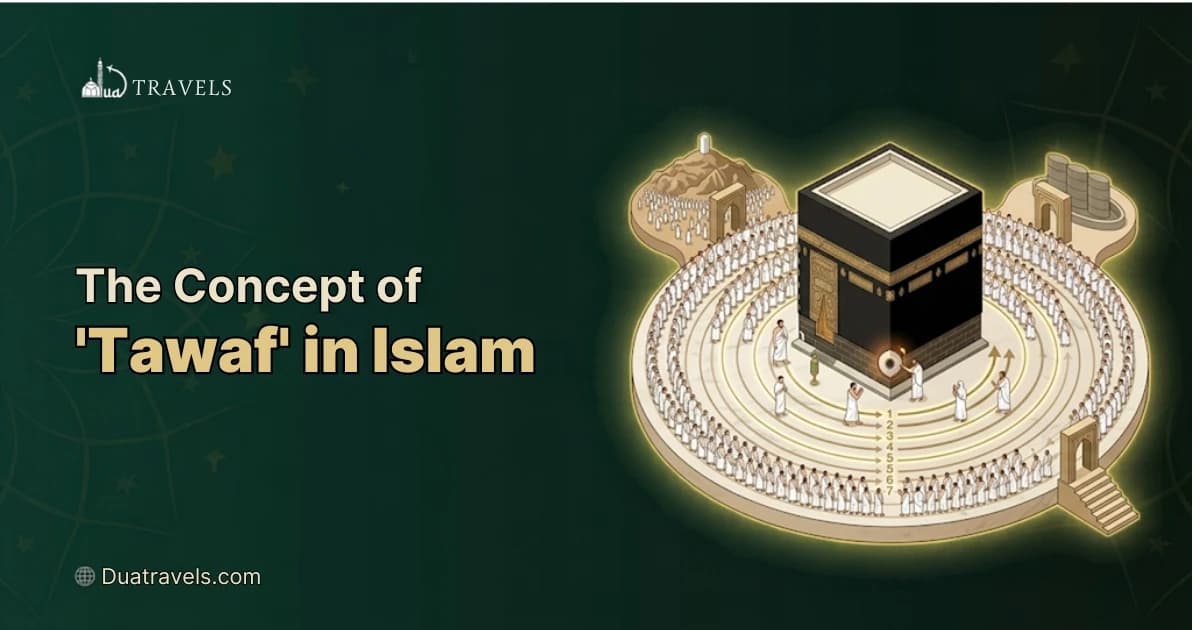
For every pilgrim who is planning to travel to the Holy cities of Saudi Arabia, Mecca and Madinah it is important to understand the actual meaning of Tawaf and what concept it holds behind. Standing in front of the Holy Kaaba to perform your sacred worship of Tawaf during Hajj or Umrah, is often considered as one of the most emotional and spiritually uplifted moments of your worship. Tawaf is the point where pilgrims are involved in physical, circular and emotional performance while experiencing a deeper connection with Allah SWT at the grounds of Holy city, Mecca. Tawaf is far more than just indulging yourself into a spiritual walk. It is mainly a ritual that gives you a chance to experience your faith that makes you connect with the Creator while asking for sincere repentance from your previous misdeeds.
Looking to Book an Affordable Umrah From USA?
Explore ATOL-protected Umrah packages from the USA and secure Early Bird Discounts with Dua Travels.
What Is Tawaf?
Tawaf (طواف) sybolises an act in which Muslims revolve around the sacred Kaaba (The House of Almighty SWT) which is positioned in the center of Mecca also known as Masjid al-Haram. Pilgrims circulate around it to complete seven rounds in a counterclockwise direction. Each round is called a shawt, (plural is ashwat) and all seven of them together complete one Tawaf during your pilgrimage performance. The pilgrims start and end their round around the Kaaba at the point where Black Stone “Hajar al-Aswad” is placed, ideally touching or kissing it, or simply pointing toward it while reciting "Allahu Akbar" (God is greatest) if you are not able to reach to it because of the crowd.
The Different Forms of Tawaf
Not all Tawaf are similar to each other as they might not serve the same purpose. To understand the difference we have described them individually below that will help pilgrims experience the specific form and its purpose,
Tawaf al-Qudum (Arrival Tawaf) This form of Tawaf is performed on your arrival in the Holy city Mecca, mainly considered as your greeting to the House of Creator Almighty SWT.
Tawaf al-Ifadah (Tawaf of Hajj) This is the core part of Hajj, an obligatory tawaf to perform during your sacred Hajj journey. This tawaf is often performed after the standing at Arafat is completed with stays in Mina. Without this Tawaf Hajj can not rank as completed.
Tawaf al-Wada (Farewell Tawaf) Performed as a final act before leaving the sacred city, Mecca, as a final act and farewell to the sacred city.
Tawaf al-Nafl (Voluntary Tawaf) This Tawaf can be performed at any time during your sacred performance at any time by Muslims on their visit which is known as an act of extra worship outside the sacred obligatory rituals of Hajj and Umrah practice.
Why Does Tawaf Matter So Much?
A Declaration of Monotheism
The core meaning of Tawaf is the physical expression of Tawhid (the oneness of God). The pilgrim walks around a single point, undisturbed, and in company with millions of others, all going in the same direction, all having the same purpose. In the crowd around the Kaaba there is no distinction between the king and the slave, the scholar and the labourer. Every one holds equality in order to define the oneness and power of the Almighty SWT.
Echoes of the Angels
According to Islamic tradition, Tawaf is a reflection of a cosmic reality: that is, the angels circle around Allah's throne (al-Bayt al-Ma'mur) in the heavens, and that pilgrims circle the Kaaba on earth. In this way, the pilgrim's Tawaf is not an isolated act of man but is a joining to something greater, a rhythm shared by creation itself.
A Legacy from Ibrahim
It is believed that the Kaaba was constructed by the Prophet Ibrahim (Abraham) and his son Ismail AS, as the first house of worship for the one Allah. The custom of revolving around this sacred place takes back to Adam, and predates even Ibrahim according to the Muslim tradition. During the Tawaf, the pilgrim enters into a continuous line of devotion, linking themselves to the Prophets, ancestors and generations of believers who have been standing at the same location in the previous era when Islam was spreading.
Unity and Equality
The equality of mankind before God is most clearly defined in Tawaf. Pilgrims wear plain, unadorned clothing, removing symbols of wealth, creed and status. In the flowing circle around the Kaaba, differences vanish away. It is said to be a preview of the Day of Judgment, when all of humanity will be gathered together in one place with one purpose before their creator SWT.
The Inner Dimension of Tawaf
In addition to its physical appearance, Tawaf is intended to be a very personal spiritual experience. Often scholars observe that the physical movement is supposed to echo an inward movement, the heart turning inwards toward remembrance of God, momentarily removed from the world. Many pilgrims have testified to the experience as overwhelming; a sense of being small in the presence of something great, and at the same time feeling close to the Divine.
There are prayers to be recited during the Tawaf, but they are mainly personal and spontaneous, some prayers are traditionally said (especially between the Yemeni Corner and the Black Stone). Thus, the ritual of Tawaf is made a common communal act and a personal dialogue.
A Ritual That Never Stops
Tawaf around the Kaaba is performed continuously, day and night, throughout the year, unlike many rites which are performed during specific days of Hajj. The only place on earth today where worship in this manner is not interrupted is at Masjid al-Haram. The continuity itself is a message: Devotion to God is not limited to a season or a single pilgrimage, but is meant to be constant, like the circling.
Conclusion
In many aspects, Tawaf is the physical pulse of Hajj and Umrah, connecting theology, history and raw human emotion with one act of walking. It's not just seven laps around a building for the pilgrim who enters into that revolving crowd. It is a reenactment of prophetic legacy, a mirror of worship, a declaration of equality among believers and most of all, an act of literally turning toward God. This meaning gives Tawaf a new dimension, turning it from a ritual into a profound experience.