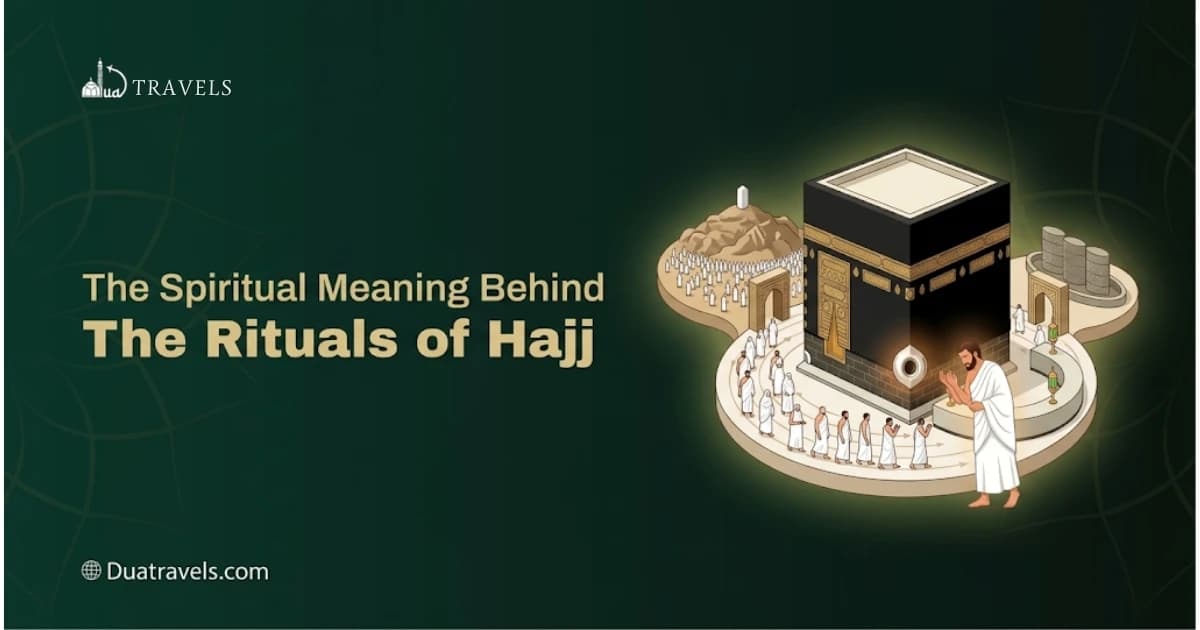
Every year, there are millions of Muslims who leave behind their homes, daily routines, and comfort in order to answer the sacred call of Hajj from the creator Almighty SWT. Being able to perform the religious worship of Hajj once in your life is a huge thing to achieve. Hajj is not just a journey to the Holy cities, Mecca and Madinah, but it mainly is a journey of sacrifice, humility, equality, and repentance to Allah SWT. It holds one of the largest annual gatherings in the world when Muslims come together in order to perform the most powerful pillar of Islam. Pilgrims, during this religious obligation are wrapped in identical white garments called Ihram in which they stand by each other despite any rank, status, and nationality, united for a single purpose in which they completely submit to the Creator of all.
If you are preparing for Hajj 2027 then this blog guide will help you explore the spiritual meaning behind the rituals of Hajj during the sacred month of Dhul Hijjah,
Learn following
What Hajj is
The meaning of Hajj in Islam
When Hajj 2027 takes place
Why Hajj is deeply connected to compassion and giving
Spiritual Meaning of Hajj Rituals
For every Muslim who stands before the Holy Kaaba for the first time dressed in all white to begin a strong transformative journey towards the Almighty. Each ritual of Hajj tells you about the history of Islam and past events, especially the one that belongs to Prophet Ibrahim AS and his family. The Hajj background tells you about the efforts put by a mother in search of water for his thirsty son who were left by their father in the obedience of the Almighty. Discovering the spiritual meaning behind these Hajj rituals will help you transform real quick and easily. Following are the rituals defined with proper understanding.
Ihram: Stepping into a State of Purity
Before a spiritual journey begins every pilgrim enters in the state of Ihram with pure intentions to start their religious Hajj offering. This holy state is marked when pilgrims wear spiritual white garments to cover their body according to the requirement in order to perform the further rituals. Ihram is for men while women can wear decent and modest dress for the religious offering of the worship. When you are draped in Ihram you forget everything else including wealth, status, nationality, school of thought, and outward appearance. While performing this step during your Hajj, this is the first and most powerful lesson that it gives, before Allah, all mankind is equal.
Tawaf: Revolving around the Ka'bah
Pilgrims walk around the Holy Ka'bah seven times in a counterclockwise direction, joining millions of Muslims from separate backgrounds with different languages, culture and status. During this sacred ritual pilgrims circulate around the Kaaba in a counterclockwise direction, joining millions of Muslims. Tawaf helps devote to the Almighty as there is no hierarchy during this performance the entire Ummat is united and it is made visible. Tawaf is the moment when pilgrims experience the beauty of Holy Kaaba by revolving around it, make sure that you keep reciting sincere Duas throughout this ritual as it holds great importance to Allah SWT. As there is no compulsory or fixed Dua to ask during the round of Tawaf but one is asked to point towards the Black Stone and recite Allahu Akbar to achieve more blessings throughout the stay. Also recite Duas like,
رَبَّنَا آتِنَا فِي الدُّنْيَا حَسَنَةً وَفِي الْآخِرَةِ حَسَنَةً وَقِنَا عَذَابَ النَّارِ
Translation: "Our Lord, grant us goodness in this world and goodness in the Hereafter, and save us from the punishment of the Fire."
Sa'i: The Search for Water
After Tawaf comes the ritual of Sa’i in which pilgrims walk between the hills of Safa and Marwa. During the performance of this holy ritual Muslims get an experience related to the hardships faced by the Prophet Ibrahim AS and his family. Pilgrims follow up with the footsteps of Hajar RA the wife of Prophet Ibrahim and mother to Ismail AS. While performing this holy worship you get to understand the faith of Ibrahim and his family in the Almighty, even in the depths of despair, their trust and patience remained the same which was answered by the almighty when Zamzam spring miraculously to quench the prophet’s thirst.
إِنَّ الصَّفَا وَالْمَرْوَةَ مِنْ شَعَآئِرِ اللَّهِ أَبْدَأُ بِمَا بَدَأَ اللَّهُ بِهِ
Innas-Safaa wal-Marwata min sha'aa'irillaah. 'Abda'u bimaa bada'allaahu bihi.
Meaning: "Verily, As-Safa and Al-Marwah are among the symbols of Allah. I begin with that which Allah began." (You only recite this specific verse before the very first lap when climbing Safa).
Sa’i is a ritual which mainly defines perseverance of faith under the hardship and trust that they put in the Creator SWT, even when there was no way forward. For many Muslims, walking between these hills somewhere helps them connect emotionally to a mother’s love and a reminder of the struggle that people of Allah have to go through in order to practice Islam.
Wuquf at Arafat: The Spiritual Heart of Hajj
One of the most important events in the performance of Hajj worship is the Day of Arafah. During this most pious day millions of Muslims gather for hours to reflect and pray for their heartfelt and sincere supplications from the Almighty. The Prophet PBUH claimed that,
"Hajj is Arafah."
This statement said by the Holy Prophet PBUH highlights the importance of this sacred day during the performance of Islamic pillar, Hajj. This particular moment of Hajj is often considered as one of the most emotionally overwhelming rituals of pilgrims’ lives. It can be considered as a raw start to a new life after asking for forgiveness from the Almighty for your previous sins. Arafah is mainly known as the day of seeking forgiveness and repentance when truly close to the Divine Almighty.
لَا إِلَهَ إِلَّا اللَّهُ وَحْدَهُ لَا شَرِيكَ لَهُ، لَهُ الْمُلْكُ وَلَهُ الْحَمْدُ، وَهُوَ عَلَى كُلِّ شَيْءٍ قَدِيرٌ
"There is no deity except Allah, alone, without a partner. To Him belongs all dominion and praise, and He is over all things competent."
Rami al-Jamarat: “Throwing Pebbles”
At Mina there is a ritual in which Hajj performers throw pebbles at the three pillars which represent that you are pointing towards Satan “Shaitan” who tried to dissuade or discourage the Prophet Ibrahim AS from obeying Allah’s command given to him. With throwing each pebble or stone towards the pillars, pilgrims recite "Bismillahi, Allahu Akbar" (In the name of Allah, Allah is the Greatest).
The significance of throwing each stone is known as an act of defiance against the temptation that was offered by Satan to deny the Almighty SWT. This Hajj worship helps remind you that resisting evil is an active choice that every Muslim should adopt in order to get rewarded and blessed just as Prophet Ibrahim was blessed after he was tested and proven.
Eid al-Adha & the Spirit of Sacrifice
The sacred worship of Hajj is concluded with the celebration of Eid al-Adha also known as the “Feast of Sacrifice”. It represents the willingness of Prophet Ibrahim to give up what he loved the most in order to obey the SWT. Muslims from all around the world celebrate these sacred rituals after they complete Hajj by performing Qurbani, sharing the meat among family, neighbours, and needy who are deserving. This is the event where the spiritual meaning of your Hajj performance moves from personal offering to collective compassion. The beauty of performing Qurbani is that it becomes a generous means of food on a table that might otherwise have been empty.
Final Words
The rituals of Hajj ends after the Eid is celebrated but it does not mean that the blessing and purity stays behind in Makkah while pilgrims travel back to their homelands. The lessons learned throughout the performance including equality, perseverance, faithfulness, trust and closeness to the Almighty, resistance to temptation and sacrifice for others, they all come along. It is essential for the Hajj performers and the entire Ummah to obey and follow these lessons even after the completion of Hajj. These are not just a genre of Hajj but the main principles that must be followed by every muslim practicing Islam.
قَبِلَ اللهُ حَجَّكَ، وَغَفَرَ ذَنْبَكَ، وَاَخْلَفَ نَفَقَتَكَ
May Allah accept your Hajj, may He forgive your sins and may He replace your expenditure.