
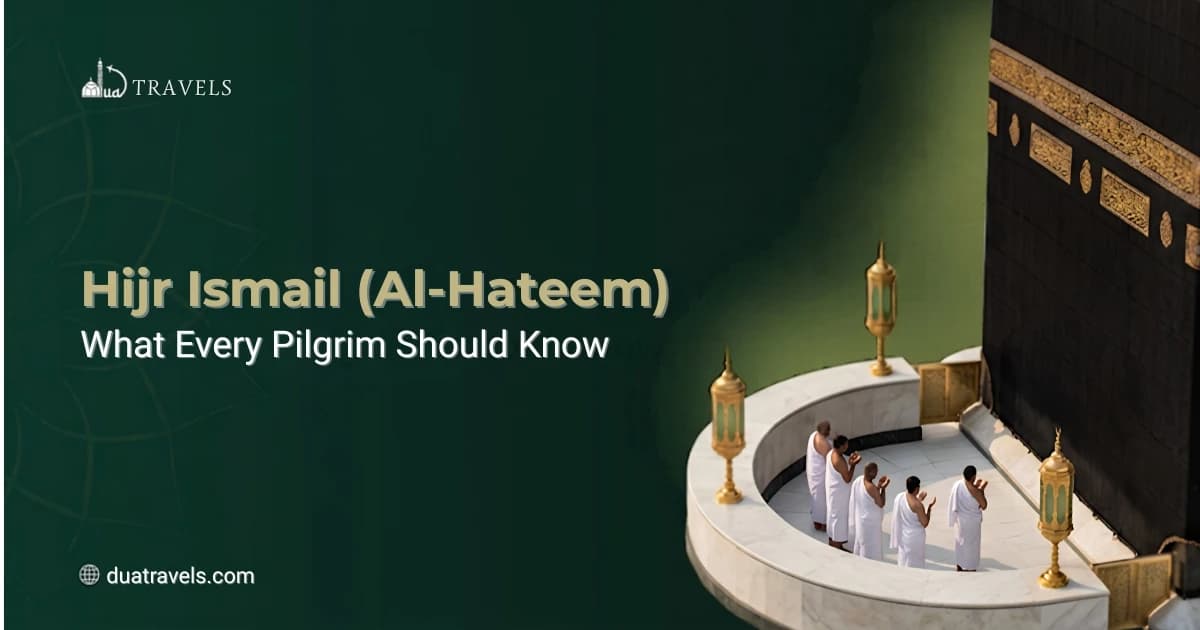
If you have ever stood near the sacred Kaaba and witnessed Muslims revolving around its north-west side, you must have seen Hajr Ismail also known as Al-Hateem. There are most of the pilgrims who walk through this sacred way during their religious ritual Tawaf without knowing the importance and understanding what it is, why it exists, or why most of the pilgrims desire to make their way inside to offer prayer. Today we will explain the importance of Al-Hateem in Islam, what the authentic sources say about it, how to pursue it during your visit, and how to avoid common mistakes while you are around it.
What Is Hijr Ismail?
Hijr Ismail is a marble semi-circular wall on the north-west side of the sacred Holy Kaaba which stands roughly at 1.33 meter height. This open and unroofed area it encloses is considered part of Kaaba itself even though it is present outside the four walls of the holy monument.
Two names are used for it:
Hijr Ismail: Referring to Prophet Ibrahim’s son Ismail AS.
Al-Hateem: Term given by some of the scholars to the semi-circular wall that surrounds the sacred Kaaba.
The key fact pilgrims need to know is that praying inside Hijr Ismail is considered as equal to praying inside the Kaaba, and it's also known as the resting place attributed to Prophet Ismail AS and his mother Hajar, AS.
What the Islamic Sources Say
The Kaaba Rebuilding and the Missing Section’
The most authentic account comes from Aisha (RA), the pious wife of the sacred Prophet Muhammad (PBUH), she asked PBUH if Hijr Ismail was part of the Holy Kaaba. He replied and confirmed that it was. He explained that when the Quraysh rebuilt the sacred Kaaba before Islam, they ran out of funds earned through fully lawful means, so they left this section outside the walls rather than build it using money they considered impure. This clarification is present in the reference of Sahih al-Bukhari and Sahih Muslim. And it's the foundation for why Hajr Ismail is treated as a sacred spot instead of an open place.
Burial Place of Ismail and Hajar
According to some of the references, Islamic scholars claim that the Hajar (AS) and her son Ismail (AS) are buried within Hateem. This is the reason why most of the pilgrims prefer to offer their sacred prayers and worship within this area, because of this they feel a connection to the past experienced by the sacred Prophets. It helps pilgrims remember the event when Hajar RA was in search of water, and the well of ZAMZAM appeared from where Hazrat Ismail AS was stamping his feet on the floor from where the sacred well of Zamzam stood.
Part of the Kaaba for Tawaf Purposes
Because Hijr Ismail is legally considered part of the Kaaba, your Tawaf is considered valid if you walk through it rather than around it. This point is considered FIQH (Islamic jurisprudence). It is an important thing to learn before you visit the sacred land for Umrah or Hajj performance.
A Basic Guide for Your Understanding
What will you see the moment you will enter: Green markers or lighting sometimes that claims that you are in the boundaries of Tawaf performance.
Why does it matter? One is that it is considered as part of the Kaaba and if you pray between this boundary it is considered as you are offering inside the Kaaba itself. And second is that it is linked to Hajar and Ismail (AS).
When to try visiting: The area is almost always crowded mainly during the Fajar salah and events like Ramadan or around Hajj season. If you want to visit it peacefully then we suggest you book outside the peak season where you will get a chance to get close enough to the Hateem point in order to offer sacred worship. Here is the best time to enter this sacred point,
Late at night, during Isha and the last third of the night
Non peak season
Outside Hajj and Ramadan season
Where exactly it is: It is positioned near the north-west side of the religious Kaaba, opposite the wall containing the Hajar-al-aswad corner so if you are facing the black stone, Hijr ismail is at the opposite point far from you.
If you are Performing for the First-time here is my experience to share,
When I was on my visit to Saudi Arabia for my Umrah performance there was a difference between trying to visit the Hijr Ismail during the day while it was quite peaceful to visit during late at night because of the crowd level. It made a huge difference in the comfort of our sacred journey. I went to visit this point after Isha prayer and there I found that there were less people late at night, the environment was calm and comfortable for those who wish to explore this Hateem point when they visit Saudi Arabia for Umrah. When I witnessed the Hateem side with my eyes I was easily able to feel the weight of a mother’s desperate search for water for her child and how with the mercy of Almighty the ground beneath his feet exploded into a well of sacred water named ZAMZAM.
Looking to Book Umrah in 2027?
Explore ATOL-protected Umrah packages from the UK for 2027 - Get Early Bird Discounts with Dua Travels
Relevant Duas
There is no accurate of occasional Dua attached or prescribed for Hijr Ismail, but many pilgrims use this time for sincere personal supplication and the following widely recited Duas:
General dua for closeness to Allah at the Kaaba:
اللَّهُمَّ إِنَّكَ عَفُوٌّ تُحِبُّ الْعَفْوَ فَاعْفُ عَنِّي
Allahumma innaka 'afuwwun tuhibbul 'afwa fa'fu 'anni "
O Allah, You are forgiving and love forgiveness, so forgive me."
Dua often recited during Tawaf, applicable as you pass or pray near the Hijr:
رَبَّنَا آتِنَا فِي الدُّنْيَا حَسَنَةً وَفِي الْآخِرَةِ حَسَنَةً وَقِنَا عَذَابَ النَّارِ
Rabbana atina fid-dunya hasanatan wa fil-akhirati hasanatan wa qina 'adhaban-nar
"Our Lord, give us good in this world and good in the Hereafter, and protect us from the punishment of the Fire."
If you manage to pray two rak’ahs inside Hijr Ismail there is no requirement to recite anything specific beyond your normal prayers.
Common Mistakes Pilgrims Make
Walking through Hijr Ismail during Tawaf. This invalidates that lap of Tawaf because the area is legally part of the Kaaba, not open ground. If this happens by accident in a crowd, that lap needs to be repeated correctly.
Pushing or forcing a path in. The physical risk is real, and it goes against the spirit of humility the space represents.
Assuming it's obligatory to pray there. It's a recommended, virtuous act if it's possible without harming yourself or others - not a requirement of Umrah or Hajj.
Confusing it with the Multazam or the Black Stone corner. These are different parts of the Kaaba's perimeter with their own separate significance.
Treating it purely as a "photo stop." Given its connection to Hajar and Ismail (AS), it's worth pausing to actually reflect rather than rushing for a picture.
Frequently Asked Questions
Is Hijr Ismail actually part of the Kaaba?
Yes. According to the hadith of Aisha (RA) in Sahih al-Bukhari and Sahih Muslim, the Prophet (ﷺ) confirmed it was originally part of the Kaaba's foundation before the Quraysh excluded it during their rebuilding.
Can I touch the wall of Hijr Ismail?
Yes, there's no restriction on touching the wall itself, though there's no specific ritual attached to touching it, unlike the Black Stone.
Do I need to pray inside Hijr Ismail during Umrah or Hajj?
No. It's a recommended act of worship when possible, not an obligatory ritual step.
Why can't I walk through it during Tawaf?
Because it's considered part of the Kaaba's structure for ritual purposes, walking through it shortens your path and invalidates that circuit of Tawaf.
Are Hajar and Ismail (AS) really buried there?
This is the widely held view in Islamic scholarship, based on early historical reports, though it isn't stated explicitly in a single Quranic verse or hadith with the same authenticity level as the "part of the Kaaba" ruling.
What's the best time to get close enough to pray there?
Late night hours, particularly after Isha and before Fajr, tend to be quieter, along with non-peak periods outside Ramadan and Hajj season.