
Everything you need to recite, understand, and feel during your Umrah journey, from the moment you enter Ihram to the final snip of your hair.
There is a moment in every Muslim’s life that they keep with them forever such as the first time they witness the beauty of Kaaba. Admiring Kaaba fades everything else; this is the time when it is essential for the pilgrims to recite as many Duas as they can. Experiencing this makes you wonder why there is no practice like Umrah that can help you get connected with the Almighty at any time of the year except the Hajj days.
It is very important for the pilgrims to understand that Umrah is not just a physical act of worship, but it actually offers a conversation with Allah SWT which is carried through Duas and various other religious acts performed during the process of Umrah practice.
The guide will help you understand a clear context behind all the Arabic verses that are asked to recite during the sacred rituals performance and why they are essential.
What Is Umrah? A Quick Answer
Umrah is mainly called the “Minor Pilgrimage” a shorter and non-mandatory act of worship or we can also call it a short version of Hajj, performed in order to seek closeness with the Almighty and His beloved Prophet Muhammad (PUBH). It can be performed at any time of the year unlike Hajj that is performed only during a specific time. Before any ritual begins it is essential for the pilgrims to offer sincere Niyyah (Intention). Duas are powerful but it is important to offer them with whole heart.
Reciting words without meaning them is like sending a letter with no address, it's the sincerity that gets it there.
Looking to Book Umrah From USA?
Explore our IATA-certified Umrah packages - find the perfect itinerary for your spiritual journey.
Why Duas During Umrah Matter So Much
The beauty of offering Dua is no less than offering a worship. Dua itself is considered as a whole act of worship as it's not just an appeal or request but a pure form of remembering the creator of everything, Allah Almighty and seeking closeness with Him. During the sacred performance of Umrah everything is paired up with specific supplications that are recited during the physical performance in front of the Holy monuments in Saudi Arabia.
To make sure that your worship goes well it is important to keep few things in your mind,
You don’t have to memorize everything through a Dua booklet or app during Umrah as it is completely fine to forget things when you witness the beauty of Kaaba. You can ask for anything that comes in your mind at that time through any quranic verse or a Dua that you have in your head. What matters is understanding and sincerity, not performance.
Make sure that whatever you recite you know the meaning of that which uplift the spiritual essence of the Dua even more.
Any sort of Duas, whether they are personal or for others, are encouraged. Make sure that you don’t forget a moment to converse with the Almighty in your own words in any language you know, and about anything that you have in your mind and heart both. Just don’t stop asking from your Creator SWT throughout your stay in the Holy land of Saudi Arabia.
1. Dua for Entering the State of Ihram
Before you are about to cross the Miqat point to enter into Ihram state which is a spiritual phase of your Umrah beginning in which male performers wear white garments with following specific restrictions. After making the sincere intentions for Umrah pilgrims recite,
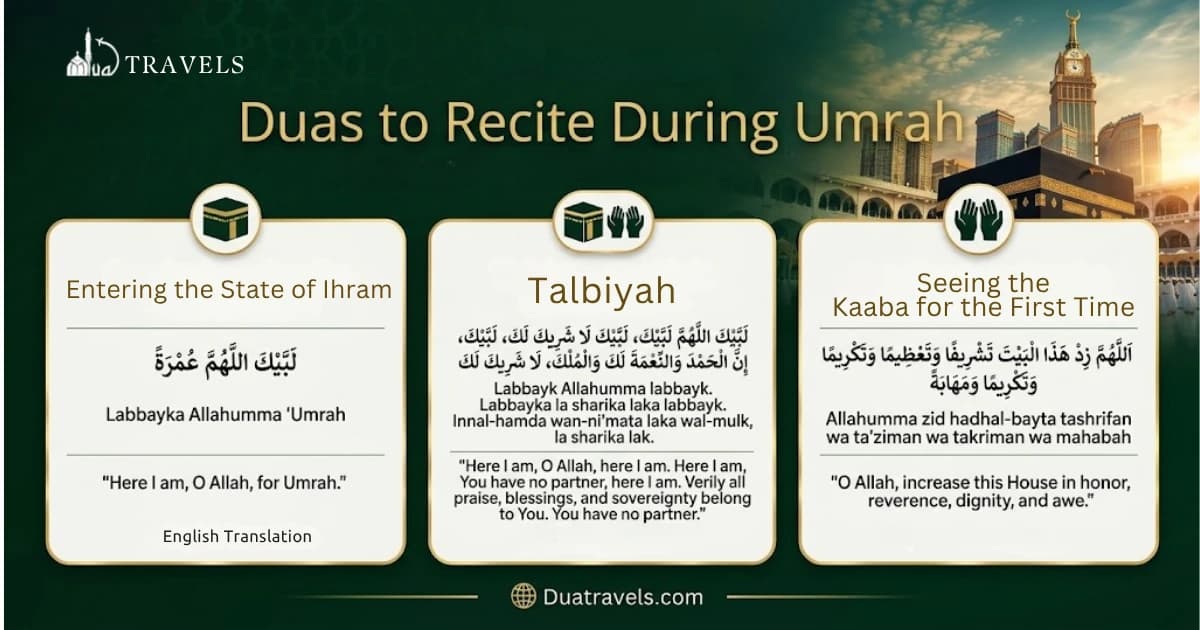
لَبَّيْكَ اللَّهُمَّ عُمْرَةً
Transliteration: Labbayka Allahumma 'Umrah
Meaning: "Here I am, O Allah, for Umrah."
When to recite: Pilgrims are asked to recite it after showering and wearing Ihram mainly during or before the Miqat state.
2. Talbiyah: The Main Dua of Umrah
If there is a symbolic Dua that defines the entire Umrah performance then it must be the Talbiyah. You will hear it from thousands of Muslim Umrah performers throughout your journey. It is meant to recite this ayat repeatedly from the time you enter Ihram and till the end of your stay in the sacred land. People usually recite it during their Tawaf ritual performance when they revolve around the Holy Kaaba.
لَبَّيْكَ اللَّهُمَّ لَبَّيْكَ، لَبَّيْكَ لَا شَرِيكَ لَكَ لَبَّيْكَ، إِنَّ الْحَمْدَ وَالنِّعْمَةَ لَكَ وَالْمُلْكَ، لَا شَرِيكَ لَكَ
Transliteration: Labbayk Allahumma labbayk. Labbayka la sharika laka labbayk. Innal-hamda wan-ni'mata laka wal-mulk, la sharika lak.
Meaning: "Here I am, O Allah, here I am. Here I am, You have no partner, here I am. Verily all praise, blessings, and sovereignty belong to You. You have no partner."
When to recite: it is ideal to recite it while you are in the sacred phase of Tawaf performance. There is no restriction on reciting it so pilgrims can offer it whenever it comes to the mind. Male performers are asked to recite it aloud.
3. Dua Upon Entering Masjid al-Haram
As we know that there are various Duas that our elders tell us to recite when we enter our house in the same way, there are Duas that we must recite when we are stepping into the pure and clean house of Almighty SWT. Pilgrims are asked to enter Allah Almighty’s house with the right foot and recite a dua of entry which is,
اللَّهُمَّ افْتَحْ لِي أَبْوَابَ رَحْمَتِكَ
Transliteration: Allahumma iftah li abwaba rahmatik
Meaning: "O Allah, open for me the doors of Your mercy."
Tip: Try to enter through the Gate of peace which is also called as (Bab as-Salam) if possible as it is mentioned somewhere but not obligatory.
4. Dua Upon Seeing the Kaaba for the First Time
There is no single obligatory Prayer for this moment and that is intentional. Many pilgrims recite:
اللَّهُمَّ زِدْ هَذَا الْبَيْتَ تَشْرِيفًا وَتَعْظِيمًا وَتَكْرِيمًا وَمَهَابَةً
Transliteration: Allahumma zid hadhal-bayta tashrifan wa ta'ziman wa takriman wa mahabah
Meaning: "O Allah, increase this House in honor, reverence, dignity, and awe."
Tip: It is said to stay in ablution throughout the journey for extra blessings and keep reciting all the Duas for an ideal Umrah completion.
5. Duas During Tawaf (Circling the Kaaba)
During the performance of Tawaf ritual, pilgrims are asked to revolve around the Holy Kaaba for seven times in which they start from the Hajar al-Aswad and end at the same point. There isn't one mandatory dua for each of the seven rounds. You are asked to offer any Dua or a general supplication during this ritual which is,
One dua specifically recommended between the Yemeni Corner (Rukn Yamani) and the Black Stone, recited during each round:
رَبَّنَا آتِنَا فِي الدُّنْيَا حَسَنَةً وَفِي الْآخِرَةِ حَسَنَةً وَقِنَا عَذَابَ النَّارِ
Transliteration: Rabbana atina fid-dunya hasanatan wa fil-akhirati hasanatan wa qina 'adhaban-nar
Meaning: "Our Lord, give us good in this world and good in the Hereafter, and protect us from the punishment of the Fire."
6. Dua After Tawaf (Praying Behind Maqam Ibrahim)
After pilgrims have completed their religious performance of Umrah rituals, Tawaf. It is suggested to pray two Rakats near the place of Ibrahim which is also known as Maqam-e-Ibrahim, if possible or else you can perform it anywhere if there is a huge crowd.
During this prayer, it's recommended to recite the following verse after Al-Fatiha:
"وَاتَّخِذُوا مِن مَّقَامِ إِبْرَاهِيمَ مُصَلًّى"
Transliteration: Wattakhidhu min maqami Ibrahima musalla
Meaning: "And take the Station of Ibrahim as a place of prayer." (Referenced from Surah Al-Baqarah)
After you have performed the 2 Rakats, go to drink ZAMZAM water and make dua while drinking it, as this is considered another moment when supplications are especially accepted.
7. Duas During Sa'i (Walking Between Safa and Marwah)
Sa'i reminds us of Hajar's (RA) desperate search for water when her son was crying of thirst, running between the two hills seven times. Once you know the story behind it, it is one of the most emotionally powerful aspects of Umrah.
Dua Upon Ascending Safa (recited before starting Sa'i):
إِنَّ الصَّفَا وَالْمَرْوَةَ مِنْ شَعَائِرِ اللَّهِ
Meaning: "Indeed, Safa and Marwah are among the symbols of Allah.
Followed by:
أَبْدَأُ بِمَا بَدَأَ اللَّهُ بِهِ
Translation: "I begin with what Allah began with."
While on a walk between the hills, General Dua:
لَا إِلَهَ إِلَّا اللَّهُ وَحْدَهُ لَا شَرِيكَ لَهُ، لَهُ الْمُلْكُ وَلَهُ الْحَمْدُ، وَهُوَ عَلَى كُلِّ شَيْءٍ قَدِيرٌ
Meaning: "There is no god but Allah alone, with no partner. His is the dominion, and His is all praise, and He is capable of all things."
8. Dua for Completing Umrah (Halq or Taqsir)
The conclusion of Umrah is when men shave their head (Halq) or cut a small portion of their hair (Taqsir), and women cut a small amount of their hair. The end of Ihram.
At this stage, many pilgrims make a simple Duas of gratitude to Allah for being able to make the journey and that it would be accepted:
اللَّهُمَّ اغْفِرْ لِلْمُحَلِّقِينَ وَالْمُقَصِّرِينَ
Meaning: "O Allah, forgive those who shave their heads and those who trim their hair."
Bonus: General Duas Every Pilgrim Should Know
In addition to the specific prayers that are uttered in the rituals, following are prayers to keep close to you during your journey:
Prayer for forgiveness: Rabbighfir li wa tub 'alayya innaka Antat-Tawwabur-Rahim " My Lord, forgive me and accept my repentance, for You are the Ever-Relenting, the Merciful.
Prayer for the families back at home: Pray for Allah to bless each person by name with health, guidance, protection and ease.
Dua of Acceptance: Rabbana taqabbal minna innaka Antas-Sami'ul-'Alim, "Our Lord, accept this from us. Indeed, You are the All-Hearing, the All-Knowing.
Common Mistakes to Avoid When Making Dua During Umrah
There are some mistakes that should be avoided when making Dua during Umrah.
Hurrying through Duas only to "get through.
Saying words without comprehension in Arabic. It still counts, but with meaning it enhances the experience so much more.
Skipping personal Duas.
The memorized ones are a basis and not a substitute for speaking to Allah in one's own words.
Forgetting who to pray for. Make a list of names of individuals who you want to made Duas on your phone, so that when the time comes it is not forgotten.
Tips for USA-Based Pilgrims Preparing for Umrah
Practice to recite a few times at home so that the duas do not forget when you are there.
Use a dua app or a printable dua card. It may be difficult to read small Arabic text, easier with a clear printed card or a phone app.
Get yourself ready spiritually, before you leave, take some time to pray and reflect on yourself along with your visa, flights, packing list etc.
Keep things simple, presence and sincerity are more important than accuracy.
Conclusion
Each of your duas, whether it is the talbiyah in the Haram or the Duas recited after Halq, is a thread that binds you to Allah. Don't aim for perfection. Aim for presence. If you are fluent in Arabic or reading from a card for the first time, it is important that you have a heart that means every word. Save this guide and share it with someone going on their journey and may Allah accept your Umrah.
Frequently Asked Questions
Is it permissible to read duas from your phone during Umrah?
Yes. It is perfectly fine to use a phone, app or printed dua card. Memorization is not as important as sincerity and understanding.
Do pilgrims have to say Talbiyah loudly?
Reciting Talbiyah is highly recommended (Sunnah) and one of the most emphasized aspects of Umrah but not a mandatory requirement.
What to do if you forget duas during the Tawaf?
There is no fixed duas that have to be recited in each round of Tawaf. One can recite the Quran, make personal duas or repeat general remembrances such as "SubhanAllah, Alhamdulillah, Allahu Akbar.
Is it okay to make duas in English and not Arabic?
Yes, Duas can be said in any language. Reciting in Arabic is not compulsory but recommended.